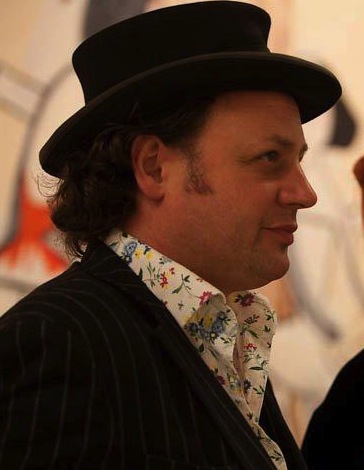
The Baron is the governor of all of my works, the character through which it all must flow.
‘A Foolish Romantic, landed up on the shores of Blighty clutching only his paintings and his hopes, The Baron is concerned with only the intensity of life itself, and the beauty of the ideal. He is raw, unflinching, and utterly sincere, a compact of all that is magnificent’.
Painting operates as a hermetic portal between an instinctive inner and outer reality as if operating as a pineal body. The act of making a painting is important, one visceral decision leads to another as the work becomes realised by applying paint directly wet into wet. I draw out the subject using whats at hand, brushes, charcoal, rags and fingers twisting and turning the paintings until images reveal a cliff edge or a space containing bathos and absurdity, something
both divine and decrepit. I invent painted narratives involving corporeal figures occupying preternatural landscapes and stage sets. They are falling or about to fall apart often in a state of transformation, reverie or catatonic breakdown. Employing the dynamics of the imagination I consider my practise as an sequential ‘visual opera’ where each new painting informs the next.
‘Touching, tender and funny. We could have filled the seats twice over.’
Elizabeth Gilmore, director Hastings Contemporary
‘With his debauched marionette’s face and terrifying magnanimity,
The Baron is a creation that makes dingy rooms glow.’
Robin Ince, comedian and broadcaster
‘The Baron is a rare bird; one with little ego and one who realises life is too short for irony or cynicism. His work comes blazing from his heart – sublime and ridiculous, beautiful and dangerous.’
Gary Goodman, painter and poet.
‘To me, the Baron is about the exploration and validation of personal experience, life in all its conflictual and unintelligible glory; in short, quality of life.’
Daniela Petrassi, audience member and collector
It was awesome! There were a hundred and twenty two paintings! The house was white and everything inside was white , except the paintings. There were paintings on the walls and paintings on easels. He has got really big paintbrushes. I like the big easels. There were black paintings and coloured in paintings. The Baron told us that artists do paintings on boards sometimes and in books and everywhere and he really likes painting! He did a painting at the station by my house and Ive got one of his pretty colourful ones with pink and yellow and it looks like fire and dinosaurs and it makes me feel happy.
by Barnaby Sadler aged 5 Catkins class visit to The Baron Gilvan’s studio.
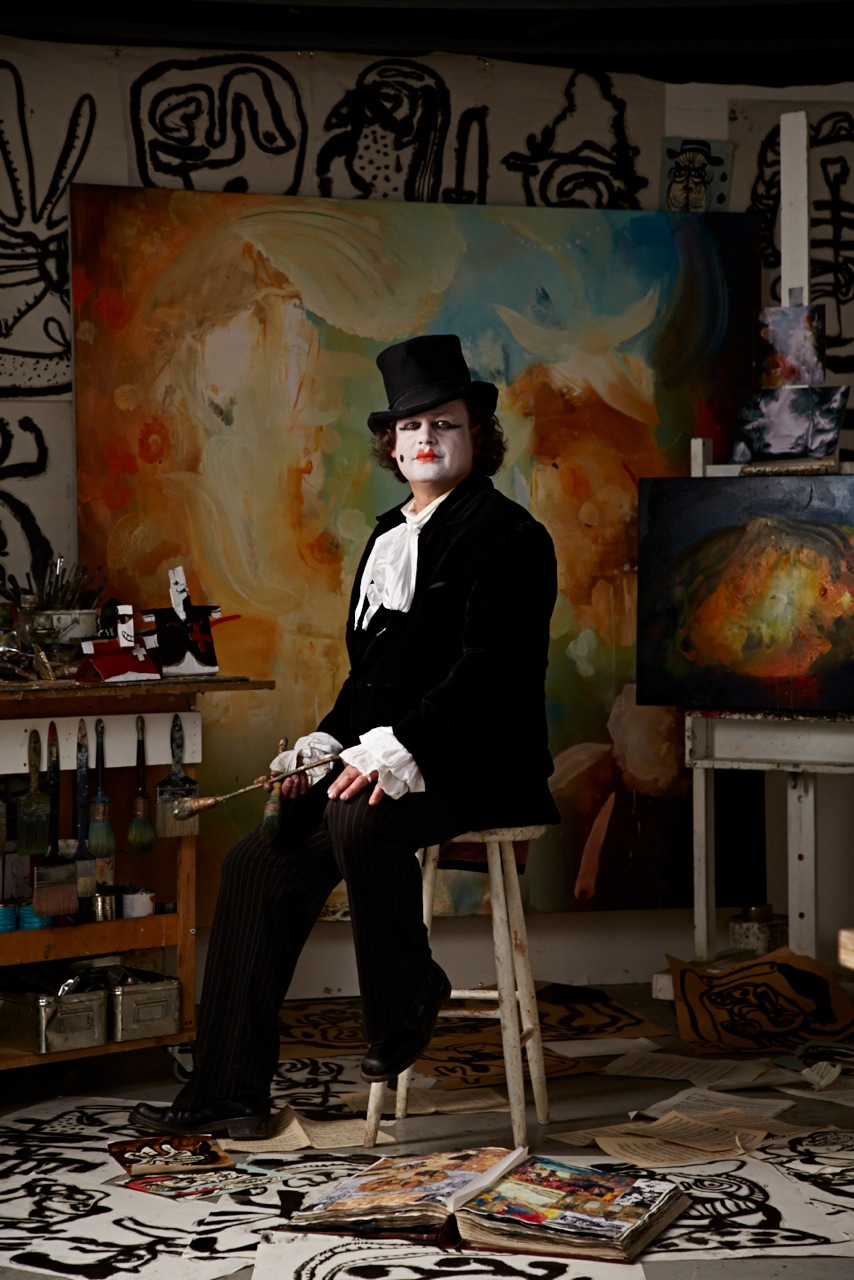
Biog
The Baron Gilvan
The Baron Gilvan is a graduate from Central Saint Martins (BaHons first class), Academy Fine Art Cracow Poland ( Painting under Prof. Nowosielski) and Turps Studio Painting programme . He was selected for New Contemporaries, FDA Futures and Artist in Resident at Glyndebourne Opera House.
He won the Royal Overseas league Travel scholarship where he painted in India and Nepal. On his return he was commissioned to design the BBC Proms logos for two seasons. He has exhibited widely and performed at the Towner Museum of Contemporary Art and Hastings Contemporary.
Works presented by The Baron Gilvan at Adelaide Salon.
“A pageant of collapse, comedy, and transcendence at the edge of the world.”
The works gathered here are fragments of a visual opera, each painting and drawing a scene in an ongoing theatre of absurdity, reverie, and survival. Under the guise of The Baron Gilvan—a dispossessed Foolish romantic clutching only his hopes and his canvases—I explore the cliff edge between the grotesque and the beautiful, where figures fall apart only to reassemble in unexpected forms.
The figures in these works are dissolving into their landscapes, or undergoing strange transformations. They are part hermit, part clown—drawn from the archetypes of medieval mysticism, modern madness, and theatrical bouffonage. These become metaphors for psychological states: breakdown, grief, dissociation, manic devotion. Yet also: survival, invention, and the deep, absurd intelligence of the outsider.
Just as galleons sink and new creatures inhabit the hulls, there is life in these ruins. A fool laughs in the dark and lights a path. A shattered admiral raises a flag in defiance or delirium. The Baron, eternal romantic, insists on beauty—even in the grotesque.
My approach to painting is visceral and instinctive. Working directly wet into wet, I let one decision lead to another, drawing with brushes, rags, pigment sticks, and fingers until forms emerge, dissolve, and reform. Each work becomes a hermetic portal, a pineal space between the inner and outer world. The drawings—charcoal and pigment on fragile newsprint—are particularly intuitive: seances of mark-making where the hand outruns conscious thought, allowing absurdities, archetypes, and subconscious dramas to rise unfiltered to the surface. In their rawness, these works are precarious yet alive, charged with the tension between the lowly (newsprint, stains, smudges) and the exalted (vision, intensity, ideal beauty).
The Baron governs all of this. He is both a character and a conduit, a mask that allows me to channel sincerity without irony. He is raw, unflinching, and foolishly romantic, convinced that even amidst collapse there remains a possibility for transcendence. Through him, I embrace painting as a compact of all that is magnificent—comic, tragic, broken, and yet defiantly luminous.
This exhibition proposes that collapse is not the end but a stage of metamorphosis. The ruins are fertile. The absurd is profound. In the laughter of the bouffon and the devotion of the hermit lies a path toward redemption. And in painting itself—the twisting of figures, the layering of marks, the conjuring of images out of chaos—there is the possibility of survival, of beauty, of light breaking through.
 The Baron Gilvan